FAQs
- New or upgraded footpaths
- Shared paths or separated two‑way bike paths
- Safer pedestrian crossings
- Road and intersection improvements
- On‑street parking where possible.
- Bate Bay Road, Cronulla
- Elouera Road, Cronulla
- Woodlands Road, Taren Point
- Acacia Road, Kirrawee
- Waratah Street, Kirrawee
- Oakwood Street, Sutherland.
- Eton Street, Sutherland between President Avenue and Flora Street
- President Avenue, between Eton Street and Acacia Road
- Banksia Road, Caringbah
Why is Council doing this?
This project aims to improve walking and cycling along Gannons Road by delivering safer paths, crossings and road changes.
It aims to make everyday trips easier and safer for people of all ages and abilities along a key route connecting local neighbourhoods.
This project supports the Sutherland Shire 10-Year Bike Plan, endorsed in December 2025, which focuses on creating connected cycling routes across Sutherland Shire with off‑road and separated paths where possible.
What will be built?
Depending on location and space the proposed improvements include:
The work will include the following lengths of each type of walking and/or cycling infrastructure, totalling around 1km:
| Footpath (metres) | Shared Path (metres) | Separated Bike Path (metres) |
Stage 1 | 260.6 | 143.8 | 102.6 |
Stage 2 | 274.2 | 133.6 | 274.2 |
Stage 3 | 76.1 | 23.2 | 150.8 |
Stage 4 | 177.8 | 29.9 | 177.8 |
Total | 788.7 | 330.5 | 705.4 |
What is a shared pathway?
A shared pathway allows pedestrians, cyclists, scooters, skateboards, wheelchairs, prams/strollers and roller skating to easily and safely commute for short trips – reducing the need to use a car.
There are many shared pathways across the Sutherland Shire that have been installed over the last 26+ years.
Shared pathways range in width from 2 metres to 3.5 metres and are concrete like footpaths. Standard footpaths range in width from 1.2 metres to 1.8 metres.
Shared pathways sometimes include central white line markings and should always have logos to indicate shared use by pedestrians and cyclists.
Councils current active transport network includes a high percentage of shared pathways within residential streets. There are many examples of shared pathways throughout Sydney and the Sutherland Shire in residential areas. In the Sutherland Shire this includes (but is not limited to):
What is a separated pathway?
A separated pathway referred to here is an off-road facility that is physically separated from motor vehicle traffic and pedestrians, and is exclusively for use by bicycles and other micromobility devices.
These facilities minimise conflict and the risk of injury for all road users. They also improve the level of service for people cycling, maximising potential ridership (TfNSW Cycleway Design Toolbox).
Council consulted with our community during the development of the Sutherland Shire Bike-Plan-2025-to-2034 (adopted in December 2025). A common theme raised by the community during this consultation was the need to separate cyclists from pedestrians and motor vehicles wherever possible.
There are many examples of separated two-way bicycle paths installed across Sydney and NSW regional centres. They are often used in conjunction with shared pathways at squeeze points (for example on the approach to intersections and adjacent to bus stops).
Separated pathways range in width from 2 metres to 3 metres and are concrete like footpaths. Standard footpaths range in width from 1.2 metres to 1.8 metres.
Below is an example of a separated pathway (two-way bicycle path) on Doncaster St, Randwick:
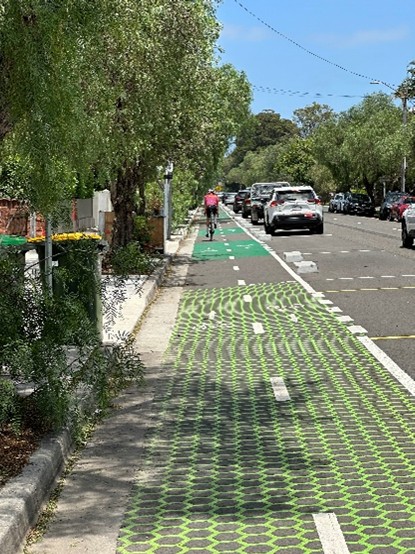
At present there are limited numbers of off-road bicycle paths within Sutherland Shire. The most recently installed bicycle paths were constructed as part of SCATL Stage 1 and Stage 2 (east) in:
This number is expected to continue to grow as demand increases for safe active transport options, particularly for short trips.
Will this affect parking?
Some changes to parking are proposed along parts of Gannons Road. Council is seeking feedback from residents and businesses to help balance safety, access and parking needs.
To allow for turning lane lengthening, bus bay and drop off bay, electrical pole and existing trees along the entire route, parking spaces will either be relocated or may be removed. This will happen in stages as the work continues.
In the first stage, 6 parking spaces will be impacted. In the second stage, 13 parking spaces will be impacted. In the third and fourth stage, 7 existing parking spaces will be impacted (Stage 3) while an additional 18 car parking spaces are proposed (Stage 4).
Council is also preparing a proposal for on-street parking reconfiguration on Dominic Street to allow for additional car parking here. This is intended to be completed in conjunction with this Gannons Road Active Transport project.
When will work start?
The project will be delivered in stages:
Stage 1: Planned for 2026–27
Stage 2: Planned for 2027–28
Stages 3 & 4: Planned for 2028–29.
Timing may change depending on approvals and funding and external utility requirements (e.g. Ausgrid power pole relocation).
Can I still drive along Gannons Road?
Yes. Gannons Road will remain open to vehicles. Some road changes are proposed to improve safety and traffic flow. We will keep our community updated on progress.
Is this going to make it harder to enter/exit my driveway?
When Council constructs a new footpath, the design of the footpath will match the levels of the adjoining driveway.
If an existing driveway has been approved by Council it will not be impacted. It is only if a driveway is unmade, paved gravel or bitumen that a section may need to be removed to match in the adjoining footpath. If modifications are required to be made to match the footpath, like materials will be used at no cost to the owner.
All reinstatement work will be discussed with impacted property owners closer to the construction of the footpath by Council or its contractors.
We encourage residents to get in touch with specific concerns or information regarding access to their property and surrounds to help us finalise the detailed design before construction by getting in touch with the project team via Trafficandpublicdomain@ssc.nsw.gov.au by 23 June 2026.
Is this project in response to e-bikes?
This project is responding to this area which has been a heavily used route for school aged cyclists for many years.
The decision to install a separated pathway where space allows between the Kingsway and Burraneer Park, is based on recommendations in the TfNSW Cycleway Design Toolbox Guidelines that were released in December 2020, as well as public feedback on our 10-Year Bike Plan consultation.
With regard to micro-mobility devices, TfNSW advises where bicycles, e-bikes and other wheeled devices can be ridden.
Council continues to advocate to state and Federal government regarding this issue – learn more on our website.
Will trees be impacted?
As part of the design process for new shared pathways and footpaths, Council’s Tree Management Officers inspect all trees along the street which may be impacted by the pathway.
Maintaining trees and managing future growth is a priority and considered in the design process. Trees that will need to be removed (approximately 19 in total over the 4 stages) have either been considered unhealthy or there is no alternate solution to pass the tree.
Any trees that are removed will be replaced according to Council’s Tree and Bushland Strategy which has a 4:1 replacement ratio.
Significant trees will be retained where possible however some trees may require removal to facilitate the pathway improvements and services.
The replacement trees may not necessarily be placed in the Gannons Road Reserve but will be provided in the Caringbah South/Burraneer/Woolooware area.