FAQs
Risk-informed and evidence-led
Locally grounded
Engagement and inclusion
Equity, justice and care
Shared responsibility
Capacity building
Innovation and continuous learning
Integrated action
- Shocks are sudden events that disrupt daily life, like extreme storms, bushfires or health emergencies.
- Stresses are ongoing pressures that build over time, such as housing stress, rising inequity, family violence or poor transport.
Aboriginal and Torres Strait Islander peoples and culturally and linguistically diverse communities requiring culturally appropriate engagement and accessible information
Older residents and people with long-term health conditions or disability, particularly in relation to mobility, isolation and access to services during disruptions.
People living in rental accommodation, social housing or community housing who may face financial stress, reduced access to services, and limited capacity to make resilience and adaptation improvements to their homes.
Young people facing housing insecurity and barriers to mental health support.
Community and social services (including financial aid)
Community infrastructure, including sports and leisure assets
Emergency services
Flood management infrastructure
Food and retail logistics supply chain
Foreshore, marine and ports infrastructure
Health infrastructure
National parks and reserves
Public open space, playgrounds and street furniture
Social and community housing
Recycling and waste management infrastructure
Roadways and road transport infrastructure
Water supply.
What is a resilient community?
A resilient community is one that can prepare for, respond to and recover from challenges while continuing to support the wellbeing of its residents.
This includes having strong social connections, reliable services and infrastructure, healthy natural environments, and people who can help one another during difficult times.
Resilience isn't just about responding to emergencies. It's also about making sure our community can adapt to longer-term challenges such as climate change, rising living costs, housing pressures and changes in the economy.
Sutherland Shire Council has used the Australian Local Government Association’s definition of a resilient community as:
“Socially connected and has infrastructure that can withstand disaster and foster community recovery. Resilient communities promote individual and community well-being and cohesiveness to strengthen their communities for everyday, as well as extreme challenges.”
What is a Resilience Strategy?
A Resilience Strategy identifies the risks and opportunities facing our community and outlines practical actions to strengthen people, places, infrastructure and services so we can better respond to future change and uncertainty.
It translates these commitments into a framework for Council and its partners to address resilience challenges, strengthen preparedness and recovery, and support long-term adaptation to environmental, social and economic change.
Why do we need a Resilience Strategy?
Community and climate resilience are recognised in the Sutherland Shire Community Plan: Towards 2035 (Prosperous and Connected and Natural and Sustainable community priorities).
The draft Strategy provides a common basis for Council, the community, government agencies, businesses and other stakeholders to identify and coordinate actions that address resilience risks across the Sutherland Shire as outlined in the Community Plan.
What approach did Council use to develop the Strategy?
Understanding risk is fundamental to building resilience. This Strategy is informed by leading resilience and risk assessment frameworks, including the Resilient Sydney Strategy 2025-2030, the Greater Sydney Resilience Risk Assessment, and the Australian Institute for Disaster Resilience’s Emergency Risk Assessment Guidelines. It also reflects the NSW Government’s Guiding Principles to Build Back Better after Natural Disasters.
Eight core resilience principles underpinned the development of the Strategy. These principles guided the assessment of risks, identification of priority focus areas, and selection of actions that will help build a more resilient Sutherland Shire:
Principle 2: Locally grounded, was supported through a comprehensive resilience risk assessment undertaken by AECOM using the same methodology applied in the Resilient Sydney regional risk assessment. This ensured the draft Strategy is founded on robust evidence while reflecting the unique characteristics, assets, vulnerabilities and lived realities of the Sutherland Shire.
Principles 3 and 4: Engagement and inclusion and Equity, justice and care, were addressed through an extensive community engagement program delivered by CRED Consulting. This work captured local knowledge, experiences and perspectives from across the community to inform the Strategy. CRED Consulting also facilitated a three-stage deliberative democracy process involving 30 community members from diverse backgrounds and life experiences. Participants reviewed the findings from the broader engagement program, shared additional lived experience insights, and helped identify priorities and Council’s role to strengthen community resilience.
Community input gathered through surveys, pop-ups, workshops and stakeholder engagement has been a major part of the draft Resilience Strategy.
What is a risk?
A risk is something that could happen in the future that may have a positive or negative impact on people, the environment, infrastructure, services or the community.
Understanding risk involves identifying the shocks, stresses and emerging trends that affect the systems, services and places on which people depend, and recognising how these risks are experienced in everyday life.
A resilience strategy helps us deal with both, by preparing for the unexpected and tackling the issues that make our community more vulnerable.
Why does the draft Resilience Strategy focus on priority communities?
Community engagement highlighted that while shocks affect all residents, their impacts are not experienced equally across Sutherland Shire.
Priority communities may experience increased vulnerability due to the systems, structures and circumstances in which they live. These communities are identified by factors that influence access to resources, opportunities and overall wellbeing.
The Strategy prioritises targeted support for the following priority communities to strengthen their capacity to prepare for, respond to and recover from shocks and stresses.
It is recognised that individuals may identify with more than one of these groups, which can further increase vulnerability.
Why does the draft Resilience Strategy focus on critical assets and services?
Critical assets and services underpin community resilience because they support daily life and emergency response.
Local assets and services were assessed based on their importance to community functioning, age, exposure and vulnerability to key shocks and stresses, and the potential consequences of disruption for health, safety, equity and economic activity.
Existing governance, maintenance and resilience requirements were also considered, with lower priority given to assets already supported by robust regulatory and risk management frameworks. For example, Ausgrid’s electricity network is governed by comprehensive standards for asset maintenance, reliability and resilience, reducing the need for additional actions within this Strategy.
The critical assets and services most vulnerable to disruption and prioritised for action are:
As many of these are outside Council’s control, strengthening resilience will require collaboration with infrastructure owners, service providers and government agencies.
What is Council’s role in delivering the draft Resilience Strategy?
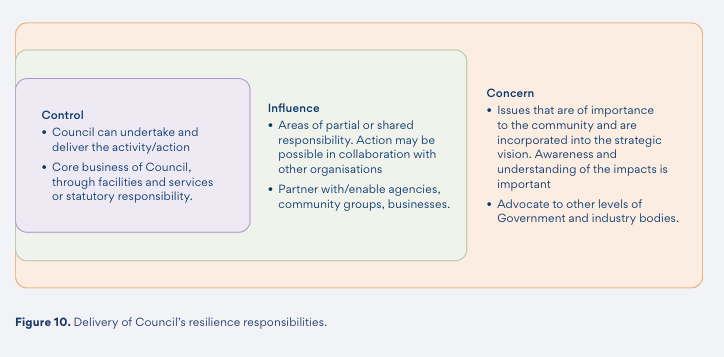
While Council has a custodial role in initiating, preparing and maintaining this draft Strategy, Council is not wholly responsible for its implementation.
Issues identified in this Strategy, such as social cohesion, cost of living, and domestic and family violence, are complex and are sometimes beyond Council’s direct control. Achieving our desired future requires collaboration. Our whole community, including government agencies, businesses, not for-profits and residents, plays an important role in delivering this Strategy.
How does our Resilience Strategy connect with the Resilient Sydney Strategy 2025–2030?
Our draft Resilience Strategy builds on the foundations of the Resilient Sydney Strategy 2025–2030, which was developed collaboratively by councils and partners across Greater Sydney, including Sutherland Shire Council. By adopting the same evidence-based risk assessment and resilience planning approach, our Strategy aligns with regional priorities while responding to the unique opportunities, challenges and aspirations of our local community.
The draft Strategy reflects the shared resilience themes identified across Greater Sydney, while being shaped by local risks, community feedback, and the lived experiences of people who live, work and visit the Sutherland Shire.
This approach ensures that the draft Strategy contributes to broader regional resilience goals while delivering practical, locally relevant actions that help our community prepare for, adapt to and recover from change and disruption.
Will the Resilience Strategy influence other Council work?
The Resilience Strategy will act as a guiding framework for how Council plans, builds, and delivers services across the Sutherland Shire. It will shape key plans and initiatives – including the Community Strategic Plan, Local Environmental Plan, Development Control Plan, Climate Strategy, and Asset Management Plans. By embedding resilience thinking through this framework, Council can better support long-term sustainability, reduce risk from shocks and stresses, and strengthen community wellbeing in everything we do.